What our theory must explain
Before building something that has to hold, you must first write down what cannot fail.
Before raising a bridge, an engineer does not start by welding beams.
First they write a list: what weight it must bear, what wind it must withstand, what length it must span, what safety margin it cannot skip.
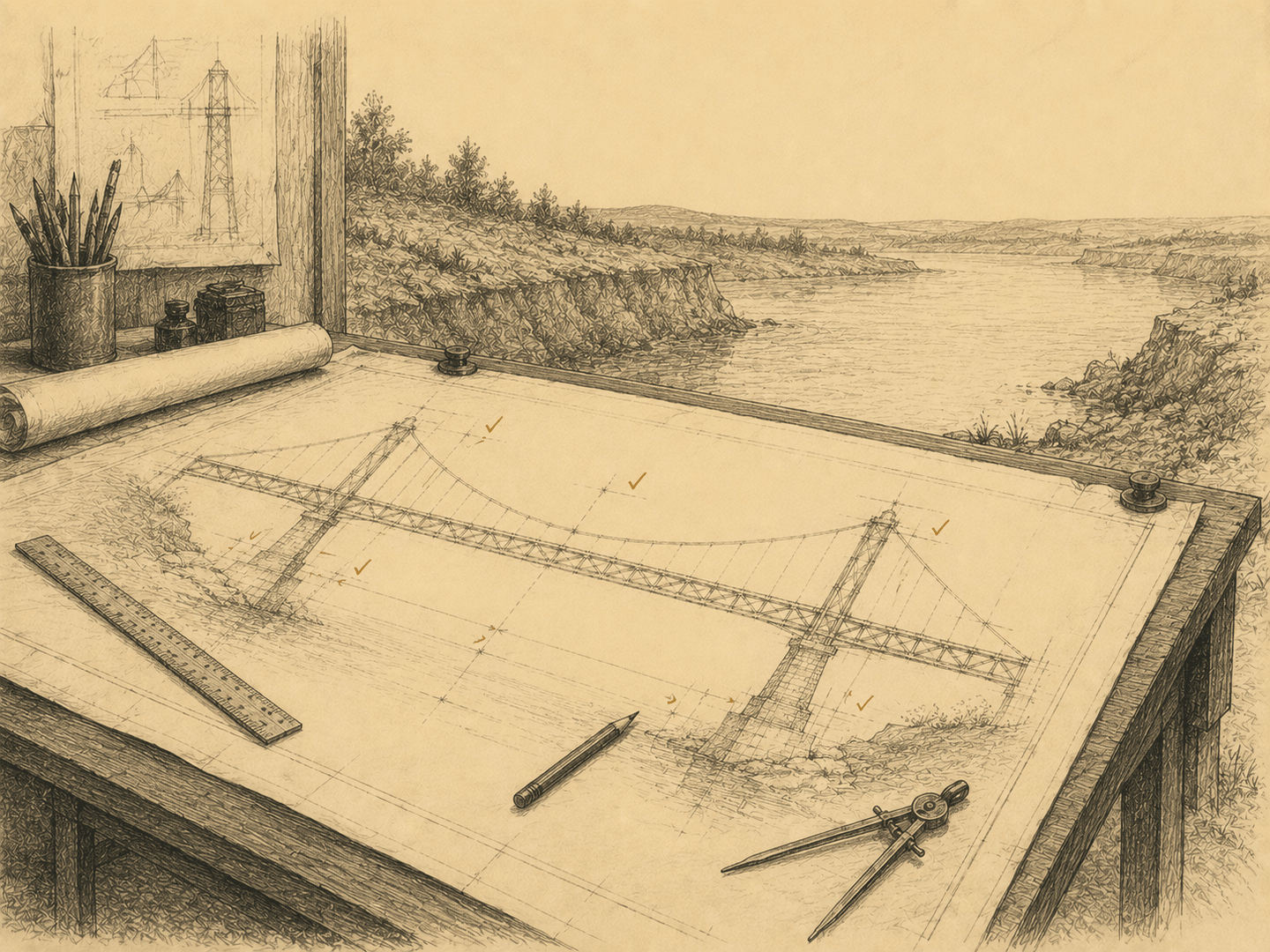
That list is not the bridge. But without it, any bridge that gets built will be, at best, a coincidence that happens to work.
We have spent eight chapters observing phenomena: a flame, a river, a melody, a wave, a bicycle, a forest, a caterpillar, a swing, a flock, an orchestra. The time has come to stop looking at new phenomena for a moment, and do something different: write the list.
What would any serious theory have to be able to explain, at minimum, in order to account for everything we have seen?
Stay with that question for a moment.
Imagine two plates, side by side.
Plate 1. Eight separate boxes, each with a different scene: the flame, the melody, the wave, the bicycle, the forest, the caterpillar, the swing, the flock.
Plate 2. The same eight boxes, now connected by a single line running through all of them, and at the center, one shared question: "what relation holds, and why does it sometimes break?"
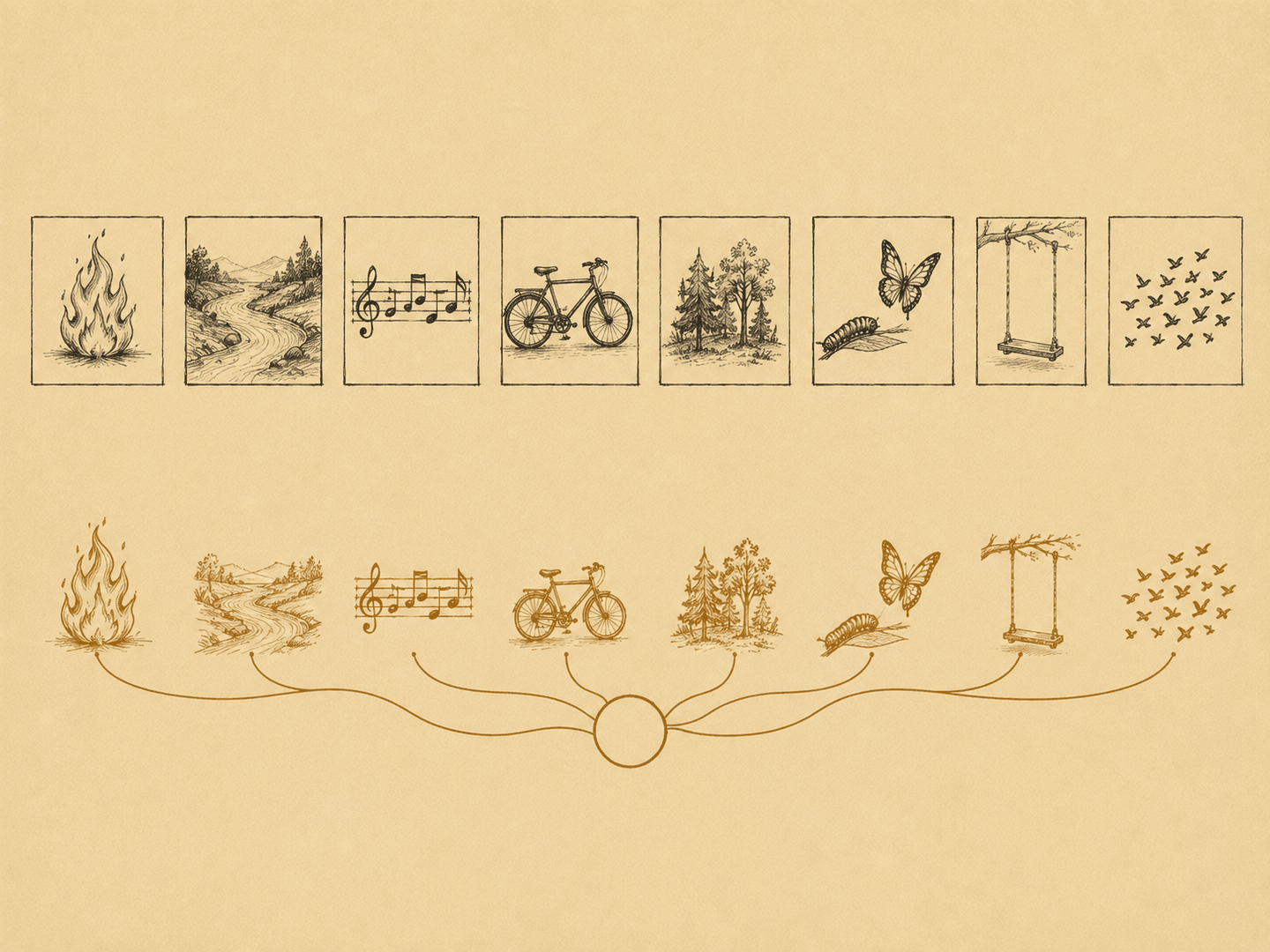
The first plate is what we have observed. The second is what we have to demand of any theory: that it answer that same question, for all eight cases at once, without changing vocabulary every time the phenomenon changes.
Let's go through, one by one, what each chapter put on the table.
The flame and the river taught us that identity can hold without matter staying fixed. A serious theory has to be able to explain that: continuity without material permanence.
The forest and the orchestra taught us that, sometimes, organization explains more than the list of pieces. A serious theory has to be able to say when that happens, and why.
The bicycle taught us that stability can be sustained through continuous change, not in spite of it. A serious theory has to be able to explain stability as a kind of change, not as its absence.
The swing taught us that recognizing a pattern is recognizing a relation that repeats, not an isolated photograph. A serious theory has to be able to say what makes a relation count as a pattern.
The flock taught us that a pattern can break without any piece disappearing. A serious theory has to be able to explain, with the same language that explains a pattern's formation, its fracture as well.
Here something worth pointing out clearly appears. How many times, across these eight chapters, did we need to ask what material something was made of in order to explain what actually interested us? Not once. Every requirement we have just written asks how a system holds together, how it transforms, or how it breaks. None asks what it is made of.
It is strange to discover that, after eight chapters observing flames, rivers, forests, and living beings, we have written a complete list of requirements without mentioning the material they are made of even once. Perhaps that is telling us something deep about the kind of question we are really trying to answer. Most of the explanations we learn as children start with the material; here, not once has it been necessary.
There is still one more requirement, and it may be the most demanding of all: the theory has to be applicable, with the same language, to a flame and to a flock of birds. Not one language for fire and another for birds. Just one, capable of moving between completely different domains without losing precision.
Let's put it in writing, the way the engineer would before the bridge.
Minimum requirements
A theory of persistent organization must be able to explain:
✓ Continuity of identity without material permanence.
✓ When organization explains more than composition, and why.
✓ Stability as a form of continuous change, not as its absence.
✓ What turns a repeated relation into a recognizable pattern.
✓ The fracture of a pattern with the same language that explains its formation.
✓ All of the above, with a single vocabulary, applicable to domains as different as fire, a forest, or a flock.
This list is not a theory. It is, like the engineer's paperwork before the bridge, the condition any theory would have to meet in order to deserve our trust.
It is worth being honest about one point. This list does not yet tell us whether such a theory exists, or whether it is possible to build one. It only tells us what it would have to be able to do, if it existed.
Why this forces the next step
This chapter has not proposed any theory. It has done something more modest and, at the same time, more necessary: writing down the minimum conditions any serious theory of persistent organization would have to satisfy.
That leaves a pending question, and it is deliberately uncomfortable: of all the languages we already know — that of objects, that of chemical formulas, that of the equations of motion, that of common sense — is there one that meets, all at once, the six requirements on the list?
If the answer were "yes," this book could end here. But before answering, it is worth looking carefully at whether any of those languages truly achieves it, or whether each one only covers part of the list and leaves the rest unexplained.
That is why the next step is inevitable:
Why does no language we already know seem to meet all of these requirements at once?
Key ideas
- Before building a theory, it helps to write down what that theory would have to explain, the way an engineer would before a bridge.
- The eight phenomena observed so far share the same kind of question: what relation holds, and why does it sometimes break?
- None of the minimum requirements asks what a system is made of; all of them ask how it holds together, transforms, or breaks.
- A serious theory must explain, with the same language, domains as different as fire, a forest, or a flock.
- This list of requirements is not a theory: it is the condition any theory would have to meet in order to deserve trust.
The idea we take with us
Before looking for the right answer, it helps to write down precisely the question that answer would have to solve.
Observation experiment
Choose one of the phenomena seen in previous chapters (or a new one you think of) that has a recognizable pattern.
Before writing anything, predict: what a good explanation of that phenomenon would have to explain, at minimum.
Write your own list of three to five requirements, in your own words.
Then compare your list with this chapter's and add:
- Where both lists agreed.
- What you would change or add after comparing.
To close, answer:
- Did any of your requirements ask "what is it made of"? Why do you think it did, or did not?
- Which requirement on your list seems the hardest for any theory to meet?
- Complete this sentence:
"A good explanation of this phenomenon would have to be able to..."