When patterns break
Sometimes a single instant is enough for a thousand coordinated movements to become a thousand movements alone.
At dusk, a flock of starlings draws shapes in the sky: it stretches, folds, compresses, opens, as if it were a single being breathing. No bird is in command. And yet, thousands of bodies move as one.
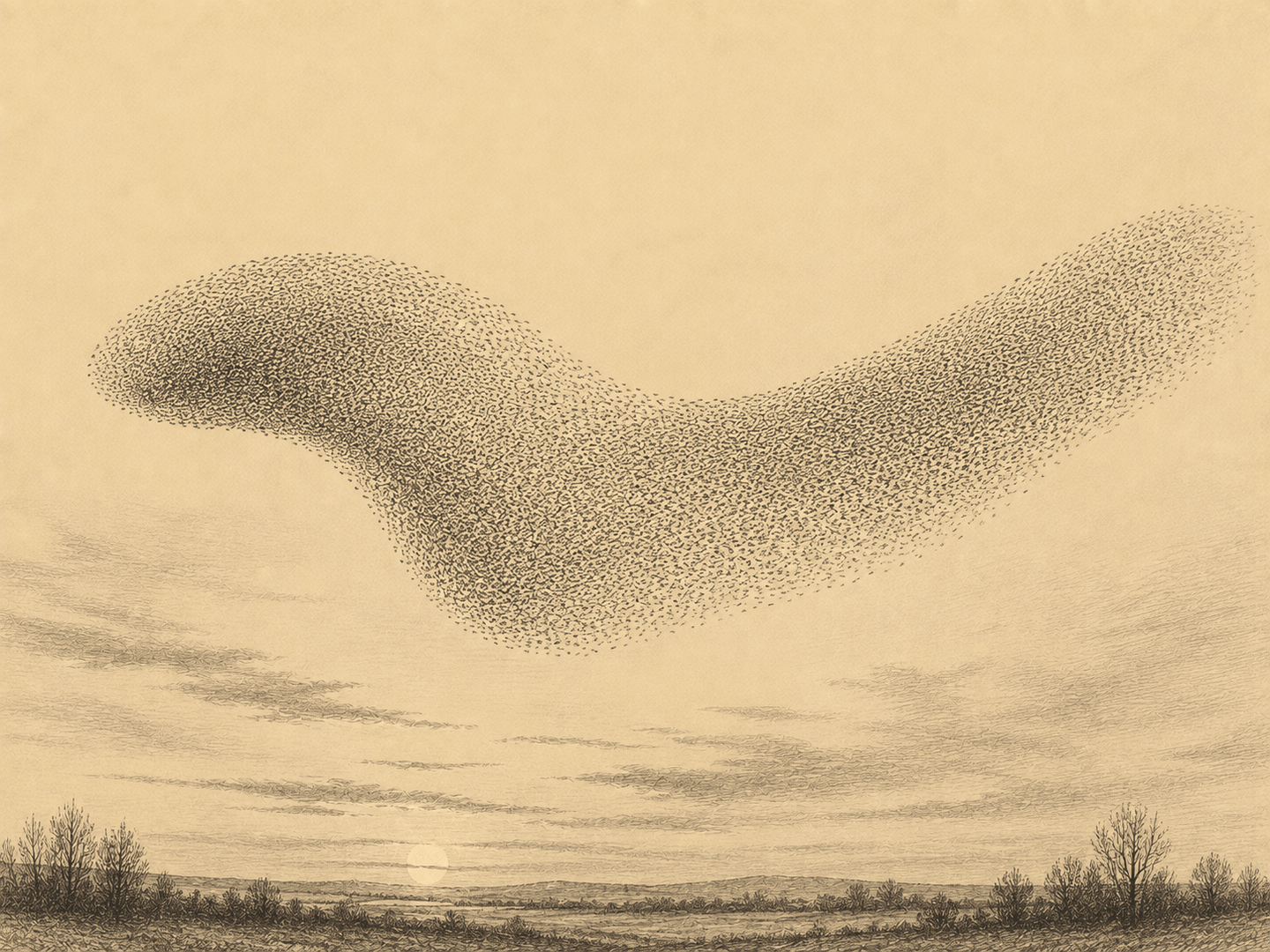
Now imagine a hawk diving in.
In a fraction of a second, the shape breaks. Where there was a single fluid figure, there are now hundreds of trajectories that no longer have anything to do with one another: each bird turns toward a different side, at its own pace, with no apparent relation to the others.
Where did the pattern go?
Stay with that question for a moment.
The birds are still there. None of them has disappeared. What broke was not the pieces: it was the relation between them. An instant before, each bird adjusted its flight to its neighbors', and the shape emerged from those adjustments. An instant later, each bird only adjusts its flight to the danger, and the collective shape dissolves into individual movements.
That is the idea of this chapter: a pattern does not break because pieces are missing. It breaks when the relation that sustained it stops repeating.
Imagine two plates, side by side.
Plate 1. All the arrows point in nearly the same direction: → → → → →. One movement, one shape.
Plate 2. The same arrows, an instant later: ↖ ↓ → ↑ ↙. Each one points somewhere different. There is no longer a shape; there are as many directions as birds.
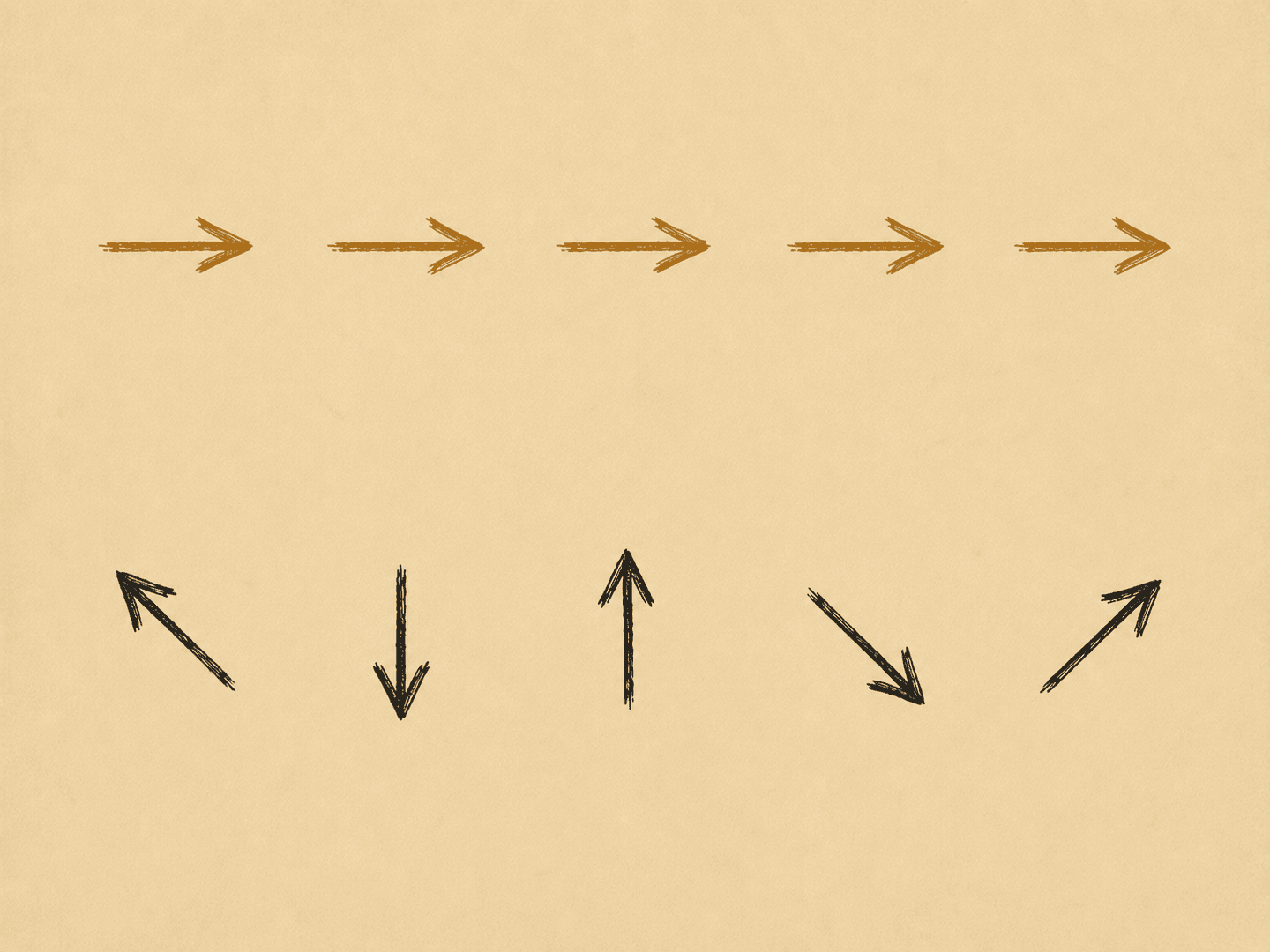
The first plate answers "what do I see?". The second answers "what broke?". And there lies the key: no bird broke. What broke was the coordination between them.
It is worth distinguishing two very different ways of losing a pattern. The first is fading: the swing from the previous chapter loses momentum little by little, each swing a bit shorter than the last, until it stops. There, the pattern fades out, but it keeps recognizing itself until the end. The second is fragmentation: the flock does not fade out little by little. It breaks all at once, and what remains no longer resembles what was there an instant before.
This distinction is not just a matter of speed. When a pattern fades, the relation between the parts weakens, but it remains the same relation. When a pattern fragments, the relation disappears completely: each part stops responding to the others and starts responding only to itself, or only to the immediate threat.
Look at three very different situations, now from the side on which they break.
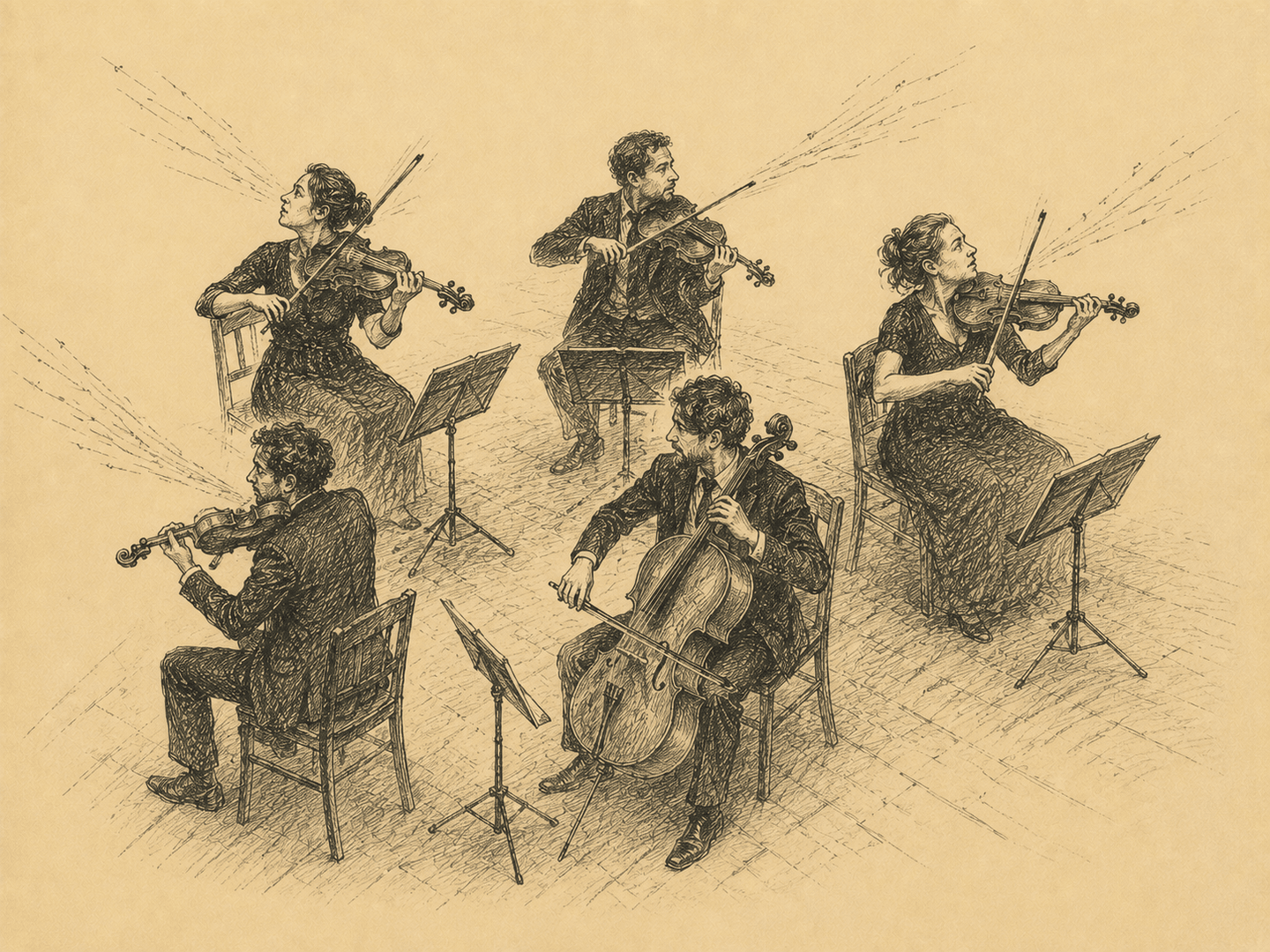
An orchestra can still have every one of its musicians. But if each one stops following the same beat, the music disappears even though the instruments keep sounding.
A conversation can lose its turns: everyone starts talking at once, no one listens to the previous speaker, and what was dialogue becomes overlapping noise.
A forest, after a severe fire, can still have trunks standing. But if the soil, the water, the fungi, and the roots lost the web of relations that connected them, what remains is no longer a forest: it is a collection of remains.
In all three cases, almost no piece disappeared entirely. What disappeared was the relation that kept them coordinated.
And here an uncomfortable but necessary question appears: why do some patterns absorb a disturbance while others break under it? The swing recovers from a small push. The flock does not recover from a hawk. The difference is not in some will to resist, but in whether the relation between the parts can keep adjusting in time. When the disturbance is too large, too sudden, or too widespread, that mutual adjustment stops being possible, and the pattern does not weaken: it fragments.
This chapter does not yet explain how much disturbance a pattern can withstand before breaking, nor what general rules govern that resistance. That remains open. What is clear is that the break is real, observable, and that it is not a simple fading out: it is the sudden loss of a relation that, an instant before, sustained a recognizable identity.
Why this forces the next step
This chapter has shown that patterns not only form: they also break, in two different ways. They fade out when the relation weakens little by little. They fragment when the relation disappears all at once. The flock, the orchestra, the conversation, and the forest all share that same possible fate.
Up to here we have described, with examples, how patterns are born and how they break. But describing with examples is not the same as explaining with precision. If someone asked us for a theory capable of accounting for both extremes — the formation and the fracture of a pattern — with the same language, what would that theory have to be able to explain?
That is exactly the question that opens the next step of the book:
What must a theory of persistent organization explain, at minimum?
Key ideas
- A pattern does not break because pieces are missing: it breaks when the relation that coordinated them stops holding.
- Fading out and fragmenting are not the same thing: one weakens the relation little by little, the other destroys it all at once.
- An orchestra, a conversation, and a forest can lose their pattern without losing almost any of their pieces.
- A pattern withstands a disturbance as long as its parts can keep adjusting to each other in time.
- When that mutual adjustment stops being possible, the pattern does not weaken: it fragments.
The idea we take with us
A pattern does not disappear because pieces are missing: it breaks when the relation between them stops holding.
Observation experiment
Choose a pattern you can safely disturb: a swing in motion, a dripping tap, or a small group walking in step.
Before observing, write:
- What you expect to happen with a small disturbance.
- What you expect to happen with a larger disturbance.
First observe the stable pattern. Then introduce a small disturbance (a gentle push, a light tap, a change of step) and note whether the pattern recovers. If it is safe to do so, then introduce a somewhat larger disturbance and observe what happens.
After observing, add:
- What actually happened in each case.
- What changed in your explanation after comparing both disturbances.
To close, answer:
- At what point did the pattern stop recovering and start breaking?
- Did it fade out little by little, or did it fragment all at once?
- Complete this sentence:
"The pattern broke when the relation between the parts could no longer..."