What stays when everything changes?
Some things seem motionless, yet in reality they never stop changing.
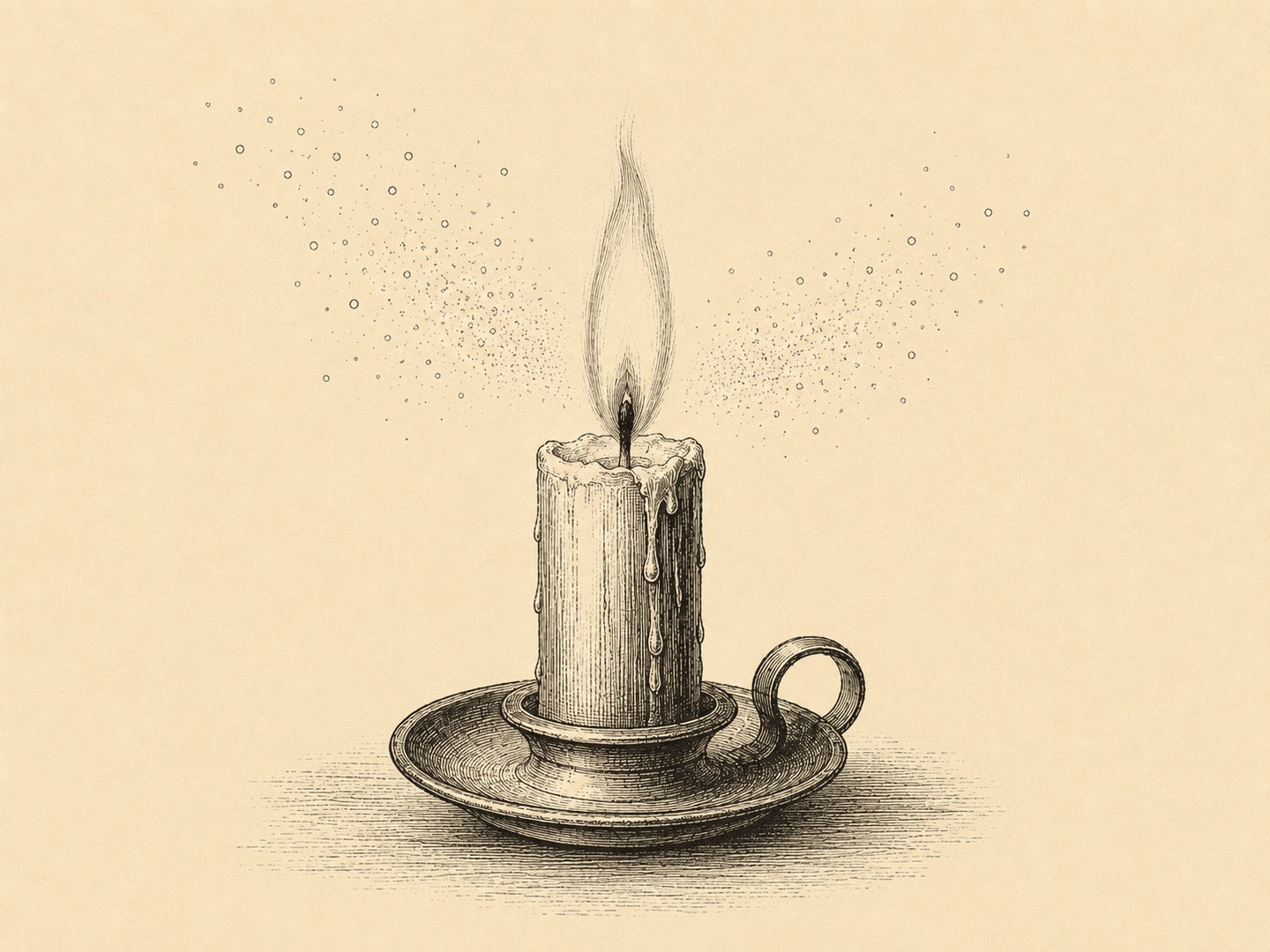
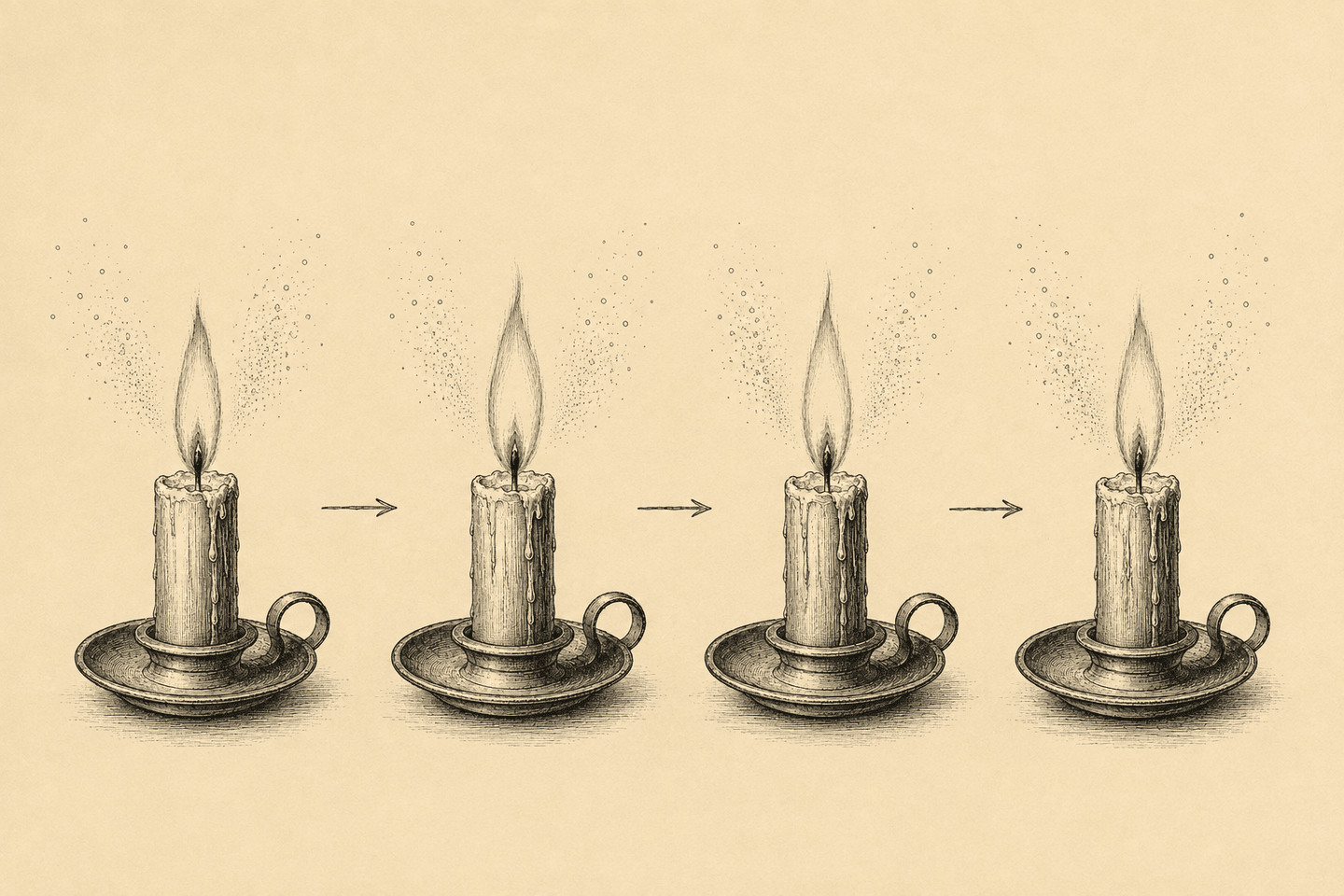
Imagine a lit candle on a table. You watch it for a few seconds, then for a minute, then for several minutes. The flame is still there: it keeps roughly the same size, a similar overall shape, and a recognizable glow. If someone walked into the room right now, they would say without hesitation: the candle is still burning.
Yet that statement hides something surprising. The flame you are looking at is not made of the same particles it was an instant ago. Fuel rises through the wick, evaporates, reacts with oxygen, releases energy, and produces carbon dioxide, water vapor, and heat. All of that material leaves the flame and is continuously replaced by new matter. Nothing stays exactly the same, and yet the flame remains recognizable.
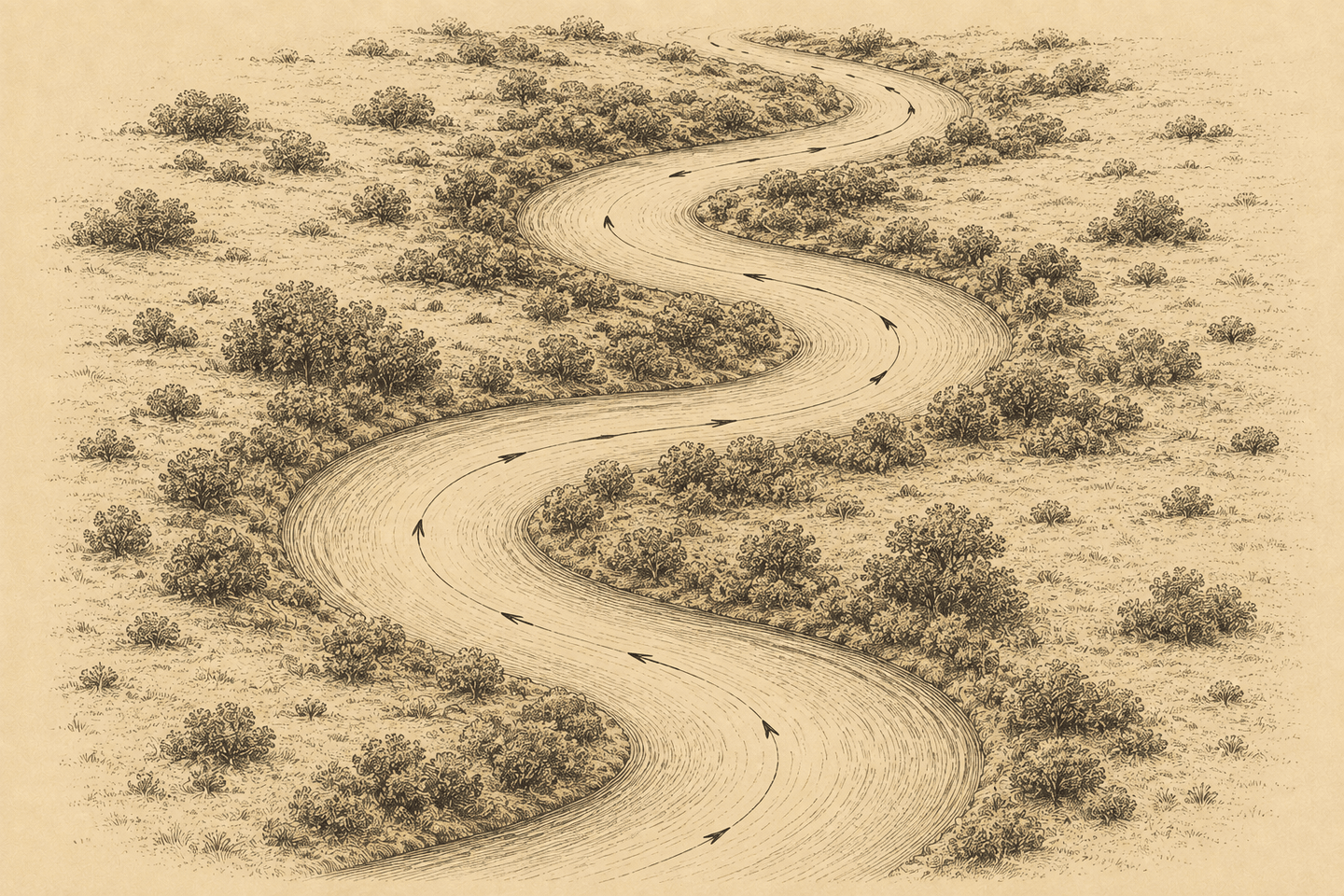
Now think of a river. You can sit on its bank for hours and watch millions of liters of water go by. None of the molecules you saw at the start will still be there a few minutes later. Even so, if someone asks where you were, you will naturally answer: by the same river.
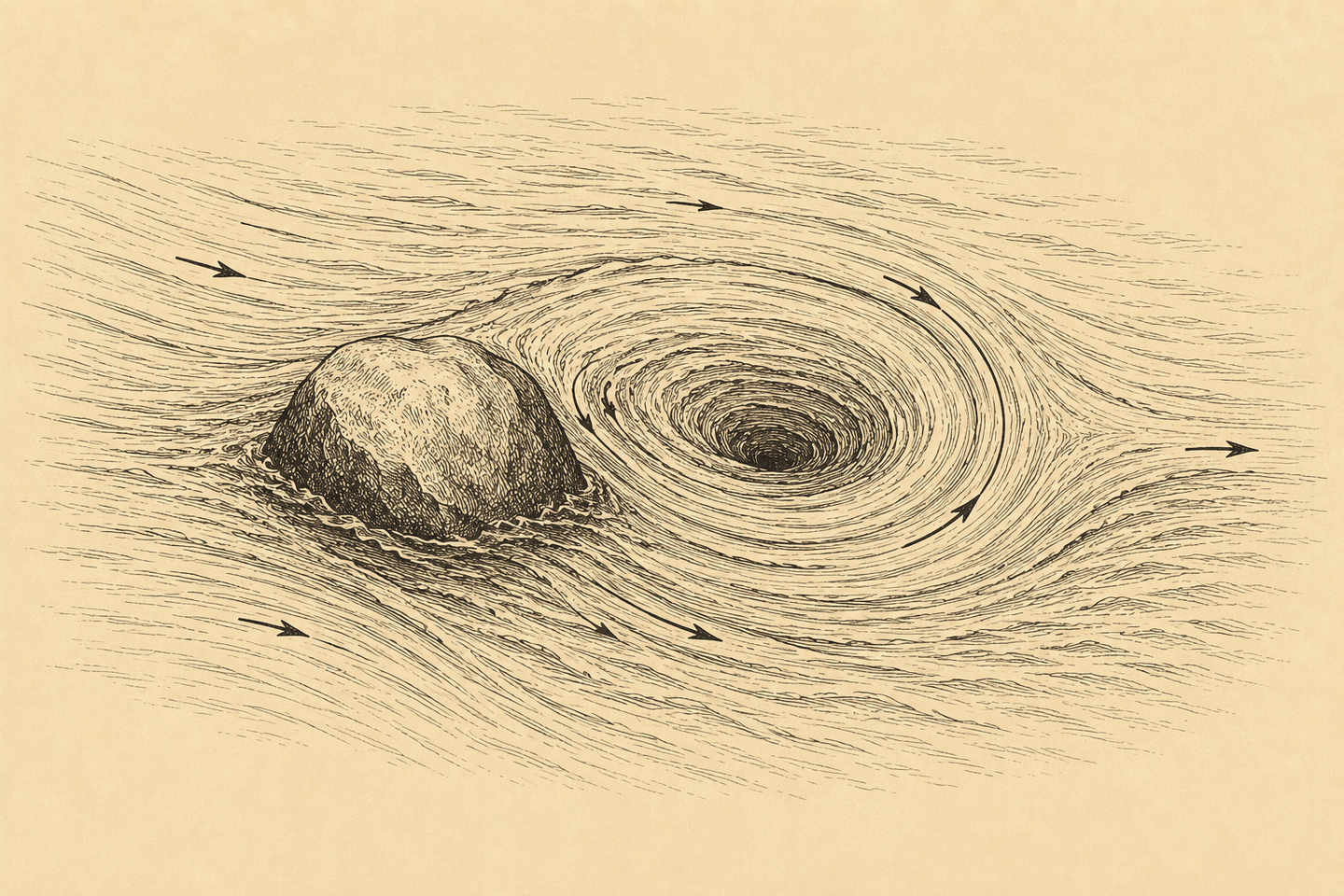
The same happens with an eddy that forms behind a rock. Water comes in, water goes out, the molecules change constantly, but the eddy persists as long as the conditions that sustain it remain. Even our own bodies work in a similar way: we breathe, eat, eliminate substances, and build new ones. Many of the molecules that make up our organism today were not part of it months or years ago, and yet we still say we are the same person.
These examples may look different from each other — a flame, a river, an eddy, a living being — but they share an extraordinary trait: they preserve some kind of identity while everything that constitutes them keeps changing. And here a question arises that sounds simple but is far deeper than it seems:
How can something continue to exist if everything that forms it changes continuously?
Sit with that question for a moment.
For a long time we have answered this question almost automatically: we assume an object is the same because it is made of the same matter. That idea works fairly well in many everyday situations. A stone on a table is still the same stone hours later; a book on a shelf keeps its components for quite a while. In those cases, equating identity with material seems reasonable.
But as soon as we look at certain natural phenomena, that explanation starts to fall short. The flame does not keep its particles, the river does not keep its water, and the eddy does not keep the molecules spinning within it.
Even a city constantly changes people, buildings, vehicles, and activities without ceasing to be recognizable. So where does its identity reside?
A first answer might be: what matters is not the matter, but the place. Perhaps the flame stays the same because it is in the same spot. But this idea doesn't hold up to much scrutiny either: a torch can move around and still be the same flame, and a hurricane can travel thousands of kilometers while keeping its meteorological identity. Position helps describe a phenomenon, but it doesn't explain why it continues to exist.
Another possibility would be to think that everything depends on appearance: as long as something keeps a similar shape, we say it is still the same. This explanation gets closer, but it also has limits. Two systems can look nearly identical and behave in completely different ways. A still photograph doesn't tell us how a system is sustained, how it responds to disturbances, or what happens when conditions change.
Appearance describes an instant; identity, on the other hand, seems to depend on something that keeps acting through time.
And here the key intuition of this chapter emerges: perhaps what stays is not the matter, and perhaps it isn't just the shape either. Maybe what truly persists is organization.
A flame does not persist because it keeps its matter; it persists because it keeps its organization.
The flame does not persist because it keeps its particles; it persists because the process that organizes them keeps functioning. The river does not persist because it keeps its water; it persists because the flow maintains a certain organization. The eddy does not persist because the molecules always spin around the same center; it persists because the collective motion continuously reconstructs a recognizable pattern.
Think also of a flock of starlings at dusk: thousands of birds change position at every instant, and yet the collective motion draws a coherent shape you recognize instantly.
It may seem like a small nuance, but it completely changes the way we observe nature. We stop thinking only in terms of objects and start thinking in terms of organized processes. We discover that some systems don't exist because their components stay still, but because they are able to reorganize them without losing their identity.
It is a shift in perspective that is simple to state but enormous in its consequences. From here on, it becomes hard to look at a flame, a river, or a living being the same way again. We no longer see only matter; we begin to see an organization that sustains itself while everything changes.
And that observation leads us, inevitably, to a new question:
If identity does not reside solely in matter, where does it really reside?
That will be the question of the next chapter.
Why this forces the next step
In this chapter we saw that many systems change internally without ceasing to be recognizable. We also saw that material persistence, by itself, is not enough to explain them. This forces us to abandon an overly simple intuition: identity = same pieces. If that equation fails for flames, rivers, eddies, and living systems, we need a more precise definition. The next step is not optional: we must locate where continuity is actually sustained. And that search opens exactly this question: if identity does not reside in matter alone, where does it reside instead?
Key ideas
- Many systems change continuously without losing their identity.
- Material persistence does not always explain the persistence of the system.
- Appearance alone is also not enough to understand a dynamic phenomenon.
- Organization can be maintained even when its components change.
- Observing nature carefully requires distinguishing between matter and organization.
The idea we take with us
A system can remain the same even as its pieces change, as long as it maintains the organization that sustains it.
Observation experiment
For five minutes, observe one of these phenomena: a lit candle, water boiling in a pot, a fountain or a river, a street with continuous traffic, or a group of people walking through a station.
Before observing, write down in one or two lines:
- What you expect to observe.
- What you think will best explain the continuity of the phenomenon.
Afterward, answer these two questions in writing:
- What elements are constantly changing?
- What aspect remains recognizable throughout the observation?
Now add two more lines:
- What you actually observed.
- What changed in your explanation after observing closely.
To close, complete this sentence:
"What stays is not the pieces, but..."