From processes to patterns
A single instant never reveals whether something repeats; only time confirms it.
Imagine I show you a single photograph of a swing, frozen right at the highest point of its arc: the chain taut, the seat motionless an instant before falling.
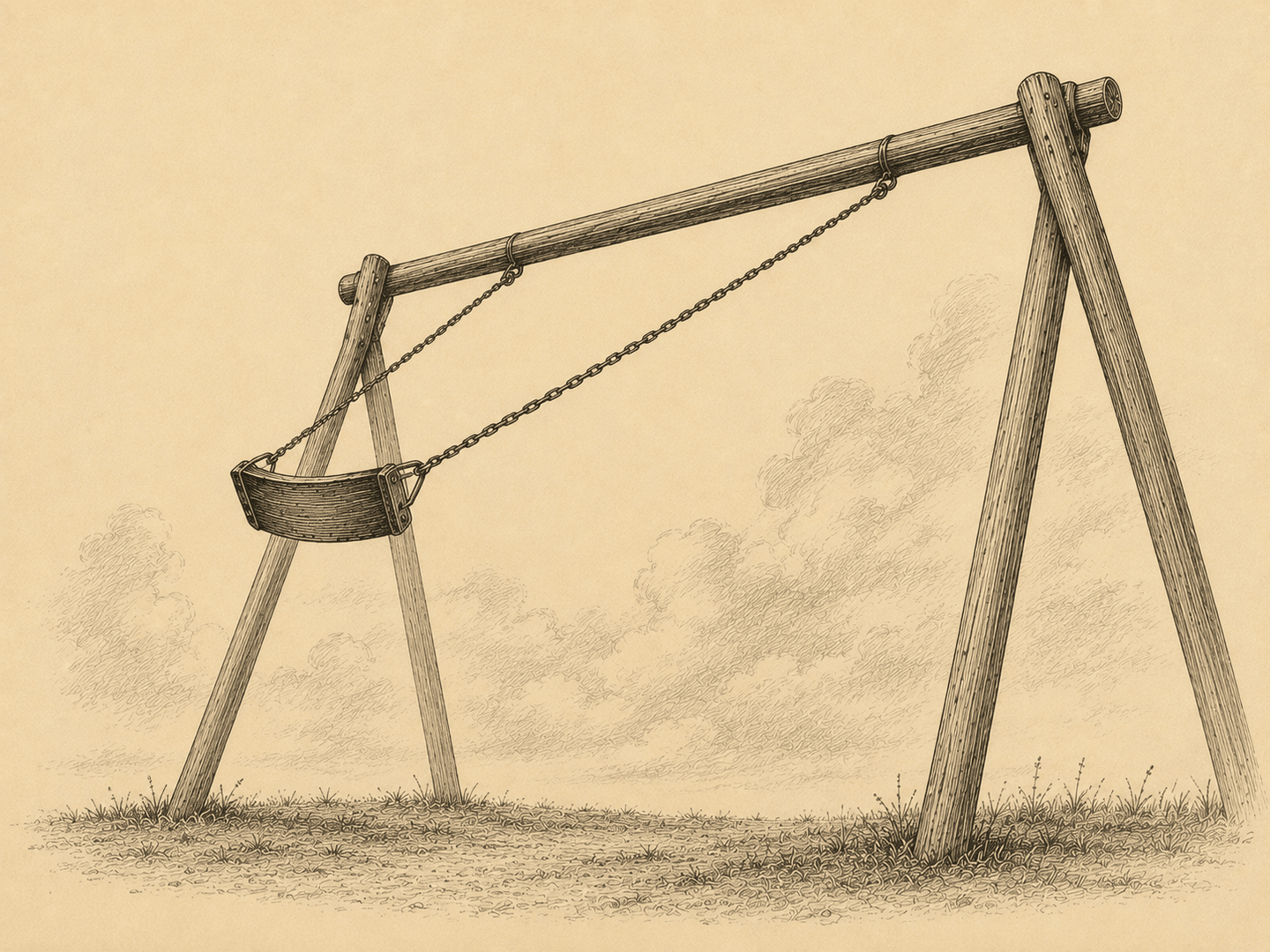
With just that image, could you say what happens next?
Stay with that question for a moment.
You can't know. The photograph doesn't tell you whether the swing is going to come down and go back up, whether someone is about to stop it with a hand, or whether it will stay still forever. A single instant does not contain that information.
Now, instead of a photograph, imagine ten seconds of video of the same swing. Suddenly everything changes. You see it rise, pause for an instant, come down, cross the lowest point, rise on the other side, pause again, and return. And with that you can already predict what comes next, even though you haven't seen that instant yet.
That is exactly what this chapter wants to point out: the difference between observing a process and recognizing a pattern within it.
Many phenomena are continuous processes, not loose photographs. But a process, on its own, still does not let you predict anything. A cloud is also a continuous process, and yet you can rarely anticipate its shape a minute from now. The swing does let you. What does the swing have that the cloud does not?
What the swing has is something very simple: a relation that comes back again and again.
It is not that each swing is identical to the last: the height varies a little, the speed changes, the momentum weakens over time. What repeats is not the exact instant, but the relation between the phases: rise, pause, fall, cross the center, rise on the other side. That relation returns again and again, even though each specific swing is different.
We call that a pattern: a relation that repeats enough that you can recognize it and, above all, anticipate it.
The curious thing is that this pattern never exists at a single instant. If you stop the swing at any moment, the pattern disappears: only a position remains, not a relation. A pattern is not a thing you can point at. It only exists while it is happening. It cannot be stored in a box: it can only be observed while it lives.
Look at three very different situations.
A heartbeat is not a loose thump that appears for no reason. It is a relation that repeats: contraction, pause, contraction, at a rhythm that can speed up or slow down, but that never stops being recognized as the same beat.
Your own steps while walking are not independent movements of each leg. They are a relation that repeats: left, right, left, right, at roughly the same rhythm each time.
A dripping tap is not a series of loose drops. It is an interval that repeats between one drop and the next.
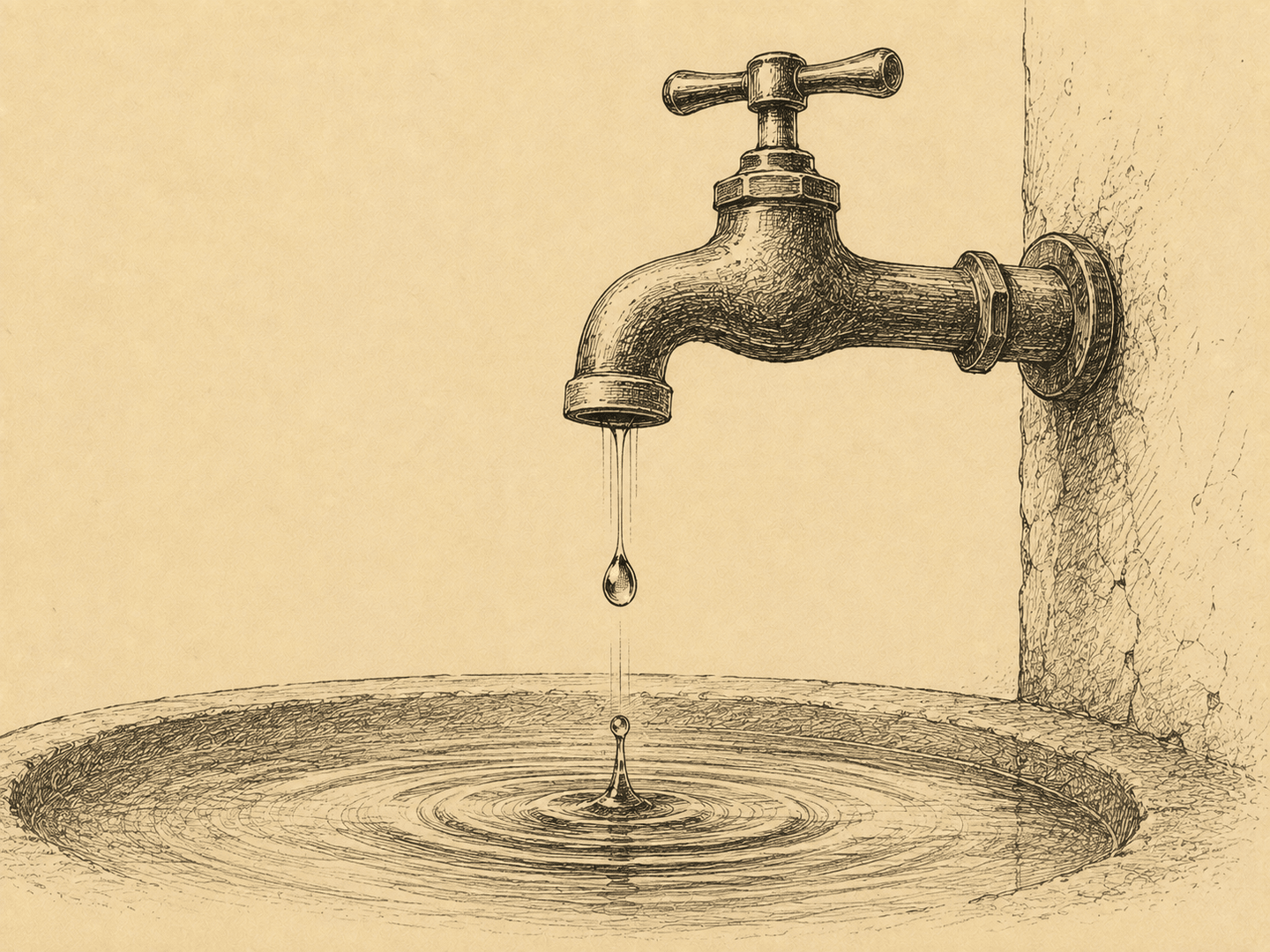
In all three cases, what you recognize is not an instant or an isolated piece. It is the relation that returns.
Imagine two plates, side by side.
Plate 1. A single photograph of the swing at its highest point. Nothing else.
Plate 2. Several photographs of the same swing across three complete swings, with an arrow that loops back from the end to the beginning, closing a cycle.
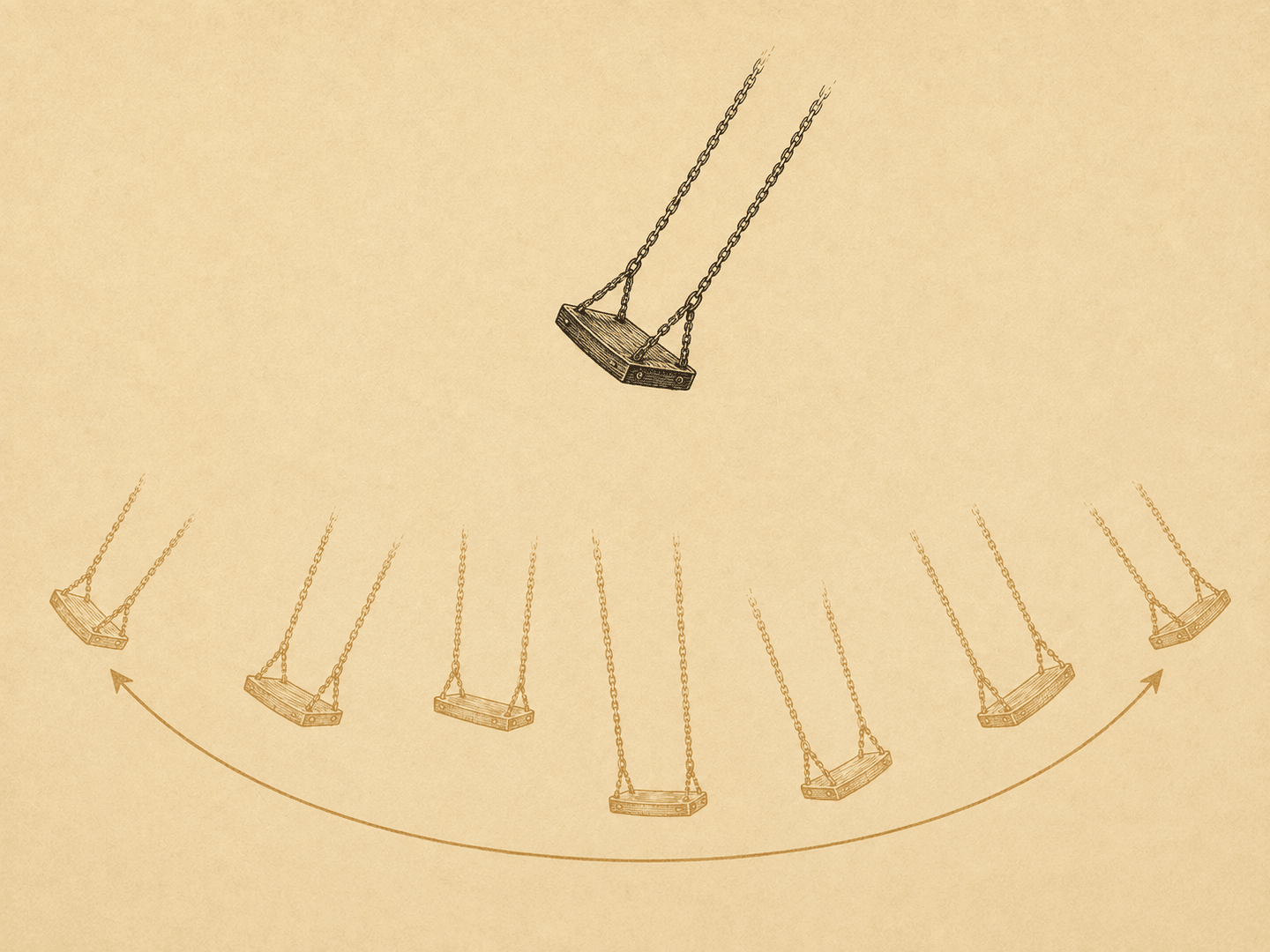
The first plate answers "what do I see at this instant?". The second answers "what relation repeats?". And there lies the key of this chapter: the first question does not let you anticipate anything; the second does, because it shows the whole cycle, not a loose instant.
It is worth being precise here. Not every process becomes a pattern. A cloud changes shape constantly, but it rarely repeats a recognizable relation between one shape and the next. A pattern is not just change: it is change organized around a relation that insists on returning.
And this matters more than it seems at first sight. When we recognize a pattern, we no longer need to see the future in order to anticipate it. It is enough to have seen enough of the past to know which relation repeats. That is, at bottom, what we do every time we say something is "recognizable": we do not memorize loose instants, we memorize relations that return.
Why this forces the next step
This chapter has shown that a pattern is neither an object nor a simple process: it is a relation that repeats enough to become recognizable and predictable. The swing, the heartbeat, the dripping tap, and your own steps share that same trait.
But we have been talking the whole time about patterns that hold up well. We have not yet asked what happens when that relation stops repeating: when the swing loses momentum and stops, when a heart loses its rhythm, when the tap starts dripping with no order, when your steps become uncoordinated.
That question is not a minor detail. It is, in fact, just as important as the previous one, because a pattern that could never break would not teach us much about what sustains it either.
That is why the next step is inevitable:
What happens when a pattern stops repeating and the system loses its coordination?
Key ideas
- A single instant never reveals whether something repeats; it takes time to recognize a pattern.
- A pattern is neither an object nor a simple process: it is a relation that repeats between successive phases.
- What repeats is not the exact instant, but the relation between the phases.
- Heartbeats, steps, and drips show that recognizing a pattern is what lets us anticipate without seeing the future.
- Not every process becomes a pattern: it takes a relation that insists on returning.
The idea we take with us
Recognizing a pattern is not memorizing instants: it is discovering which relation insists on repeating.
Observation experiment
Choose a phenomenon that repeats every few seconds: a swing, a nearby traffic light, a dripping tap, your own steps while walking, or your pulse at the wrist.
Before observing, write:
- What you expect to observe.
- What you think best defines the repetition of this phenomenon.
Watch it several times in a row. Then, just before the next repetition happens, try to predict the exact instant it will occur.
After observing, add:
- What you predicted and what actually happened.
- What changed in your explanation after comparing your prediction with the observation.
To close, answer:
- Which relation between phases was the one that actually let you predict, beyond the specific instant?
- At what point did your prediction fail, and what did that failure teach you about the pattern?
- Complete this sentence:
"What I recognized was not an instant, but a relation that..."