From things to processes
What you see as an object may in fact be an instant stolen from a longer process.
Look at a caterpillar.
Now imagine the same caterpillar a few weeks later: wrapped in a chrysalis, still, almost unrecognizable.
And a few weeks after that: a butterfly, with wings, a different color, a different way of moving.
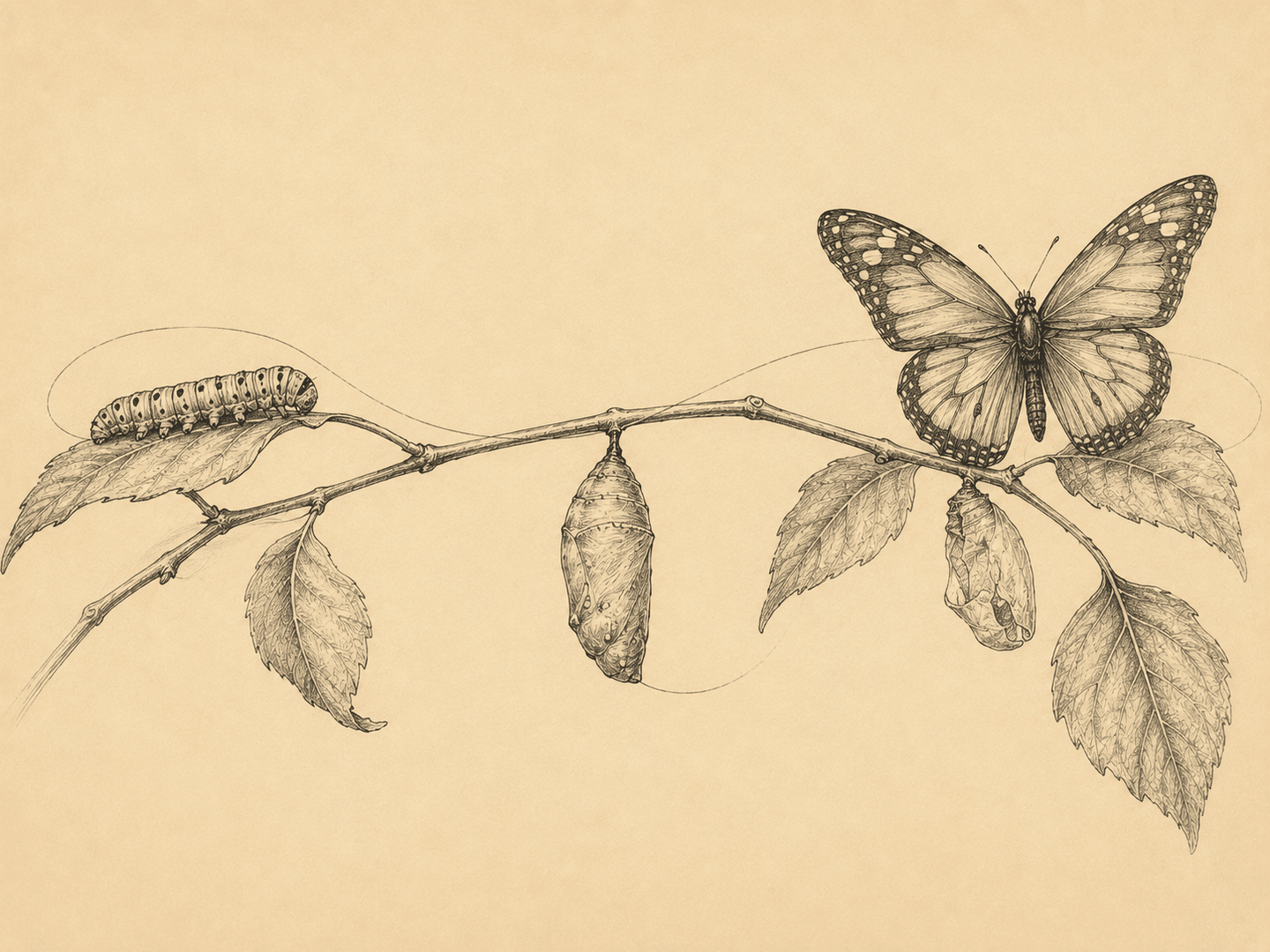
Is it the same creature?
Stay with that question for a moment.
The usual answer is "yes, it is the same one," even though it shares almost no visible feature with its starting point. But if it is the same, what exactly was it that stayed? It was not the body: it changed completely. It was not the form: it changed completely. It was not even the way of moving: one crawls, the other flies.
The only thing that did not change was something much harder to point at: the continuity of a transformation. There is no "caterpillar" object that gets replaced by a "butterfly" object. There is a single, continuous process that passes through very different phases without breaking.
That is the idea of this chapter.
When we think of metamorphosis, we usually imagine three photographs: caterpillar, chrysalis, butterfly. But nature never saw those three photographs. It only knew a continuous transformation. We invented the photographs ourselves, in order to talk about it.
For a long time we have talked about the world as if it were made of things that, sometimes, change. First there is the caterpillar. Then there is the butterfly. As if they were two separate photographs and, at some point, someone swapped one for the other.
But that is not what happens. There is no substitution of one object for another. There is a single process that unfolds in time, and the "photographs" — caterpillar, chrysalis, butterfly — are just instants we cut out of that process in order to talk about it.
Here a distinction appears that changes many things: a process is not a row of objects replacing one another. It is a continuity that transforms.
Look at three very different situations.
A film is not a stack of photographs. It is the movement between them.
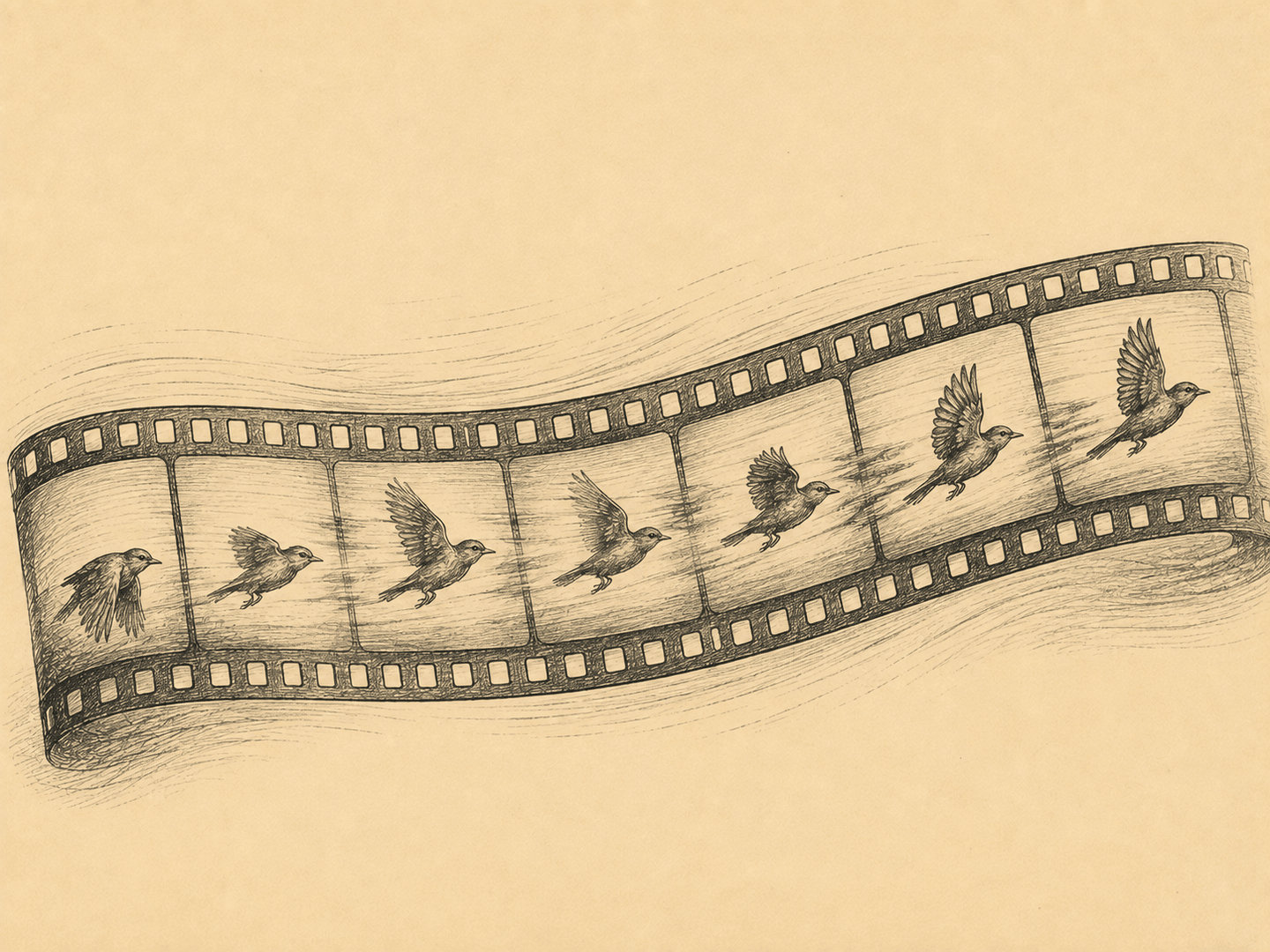
A story is not a heap of loose words. It is the thread that holds them together as they are told.
A fire is not a series of separate flames, one after another. It is a continuous combustion that keeps happening while it lasts.
In all three cases, if you only look at the "photographs" — the frame, the word, the flame of a single instant — you lose exactly what makes it what it is. What matters is not in each instant on its own. It is in the passage from one to the next.
And here an important clarification is due. This does not mean that instants do not exist, or that it is useless to describe them. A caterpillar is real. A chrysalis is real. A film frame is real. What this chapter shows is something finer: that instant, on its own, is not the basic unit of what happens. The basic unit is the process that runs through it.
Imagine two plates, side by side.
Plate 1. Three separate boxes, each with its own frame.
Plate 2. The same three drawings, without frames, joined by a single continuous amber line that flows from one to the next.
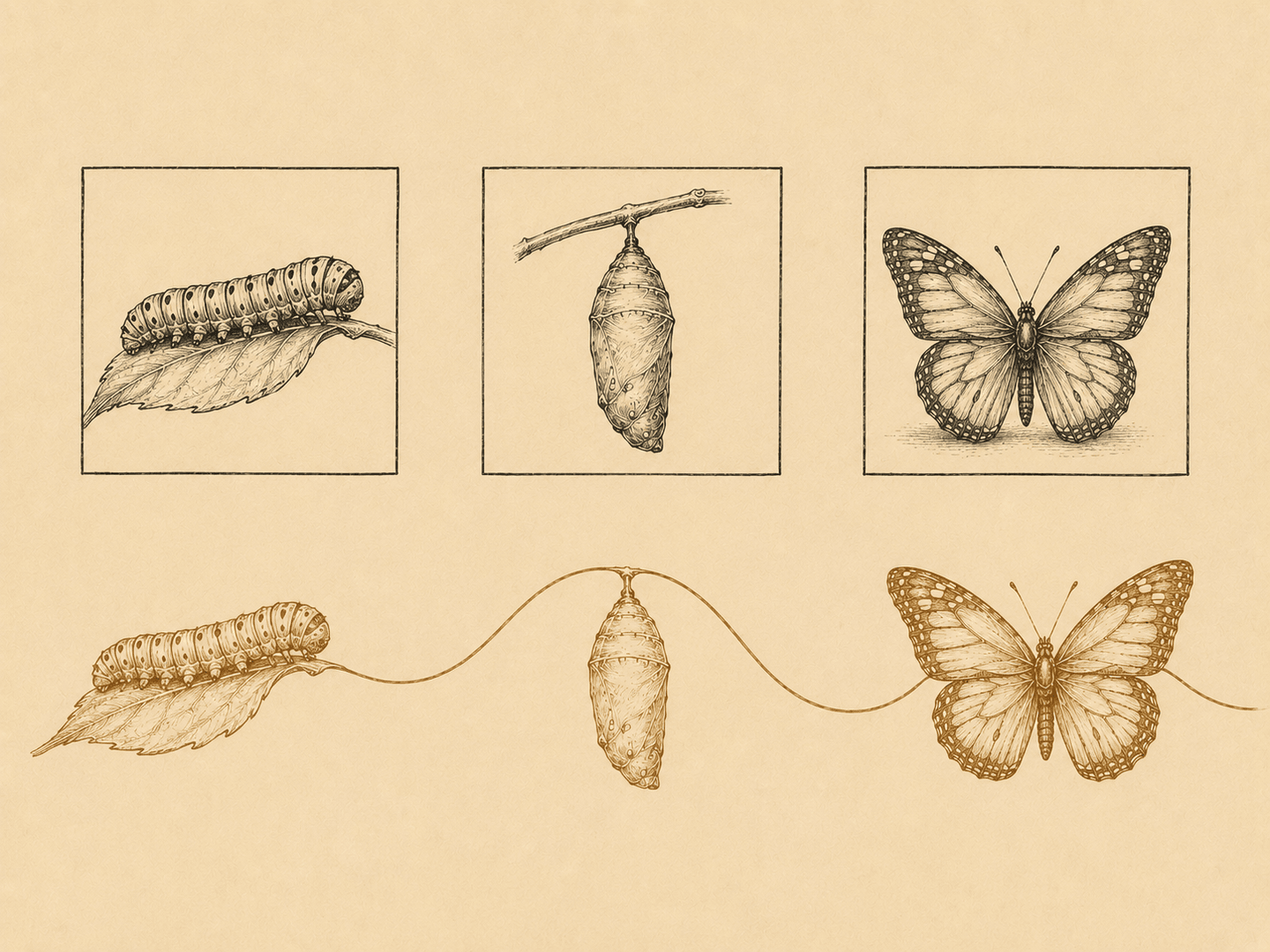
The first plate answers "what is there at each moment?". The second answers "what holds the whole path together?". And there lies the key of this chapter: that second question cannot be answered by looking at a single box. It can only be answered by looking at the whole process.
This shift — from things to processes — does not invalidate what we have learned so far. On the contrary: it completes it. The previous chapters showed that many systems endure even though their parts change. This chapter takes one more step: it proposes that the most useful unit of description is not the object at an instant, but the process that connects it with the instant before and the one after.
We have not yet said how to describe a process precisely, nor what distinguishes it from another process, nor when two processes are "the same kind of thing." That is exactly what remains to be built.
Why this forces the next step
This chapter has shown that many phenomena are better understood as processes than as objects that change now and then. The caterpillar, the film, the story, and the fire share the same trait: what is essential happens in the transit, not in the snapshot.
But a process, on its own, does not yet explain why we recognize it as "the same" through time. A caterpillar becomes a butterfly; a cloud changes shape endlessly. In both cases there is a process. Yet one we feel as a coherent transformation, and the other, often, as pure change and nothing more.
That leaves a pending question, and it is exactly the one that opens the next step of the book:
What makes a process be recognized as a pattern, instead of dissolving into simple change?
Key ideas
- Many phenomena are not objects that change now and then: they are continuous processes that we cut into instants.
- A caterpillar and a butterfly are not two distinct objects joined by a substitution; they are phases of a single process.
- Films, stories, and fire show that what is essential happens in the transit, not in the isolated photograph.
- Thinking in processes does not eliminate objects; it changes which is the basic unit of explanation.
- We still need to know what makes a process be recognized as a stable pattern and not as pure change.
The idea we take with us
A process is not a row of photographs: it is the movement between them.
Observation experiment
Choose a phenomenon you can watch transform in a few minutes: an ice cube melting, an infusion cooling, a cloud changing shape, or something cooking in a pan.
Before observing, write:
- What you expect to observe.
- What you think will best explain the continuity of the phenomenon.
For 10 minutes, note:
- What "photographs" (instants) you could take of the phenomenon.
- What is lost if you only look at those photographs separately.
- What part of the phenomenon can only be understood by looking at the whole transit.
After observing, add:
- What you actually observed.
- What changed in your explanation after looking closely.
Optional variant with video. If you have one at hand, pause any video on a single frame, look at it fixed, and try to explain what is happening in the scene. Then play it for a few seconds. Compare: what could you explain with the still frame alone, and what only became clear by watching the movement?
To close, answer:
- At what moment did the phenomenon stop looking like a thing to you and start looking like a process?
- Which isolated instant would have misled you most if you had seen it without the rest?
- Complete this sentence:
"What was happening was not in an instant, but in..."